Transforming Lives: The Inspiring Journey of the Diocesan Health Department
When the Diocese of Kinkiizi was established in 1995, its health landscape was nearly non-existent. There were no dedicated diocesan health units, leaving communities entirely reliant on a single government hospital at Kambuga. Recognizing that physical healing is a vital element of Christ’s ministry, the Diocese established a formal Health Department to supervise, develop, and elevate medical standards across the region.
Today, that humble beginning has blossomed into a world-class healthcare and educational network serving over 120,000 people. Driven by visionary leadership, international partnerships, and an unwavering commitment to remote communities, the Diocesan Health Department has become a beacon of holistic care and academic excellence in Uganda.
A Legacy of Visionary Leadership
The incredible growth of our medical services has been steered by dedicated administrators and medical professionals who turned structural challenges into community triumphs.
| Era | Leader / Coordinator | Core Impact & Status |
| Inaugural | Rev. Dan Zoreka | Laid the structural foundation for the department (Now Rt. Rev. Bishop of Kinkiizi) |
| Former | Rev. Can. Enos Komunda | Deepened rural outreach and network mobilization (Deceased – RIP) |
| Former | Ms. Katumba Ritah | Focused heavily on maternal and child health frameworks |
| Administrative Support | Mr. Philip Kanyesigye | Diocesan Health Department Administration of NHC3 |
| Former Medical | Dr. Joe Kalenzi | Advanced institutional healthcare and medical standards |
| Current Medical | Dr. Sadiiki Abel | Medical Director driving the department’s transition into advanced healthcare and specialized services |
From a Tree Clinic to an Award-Winning Hub: Bwindi Community Hospital (BCH)
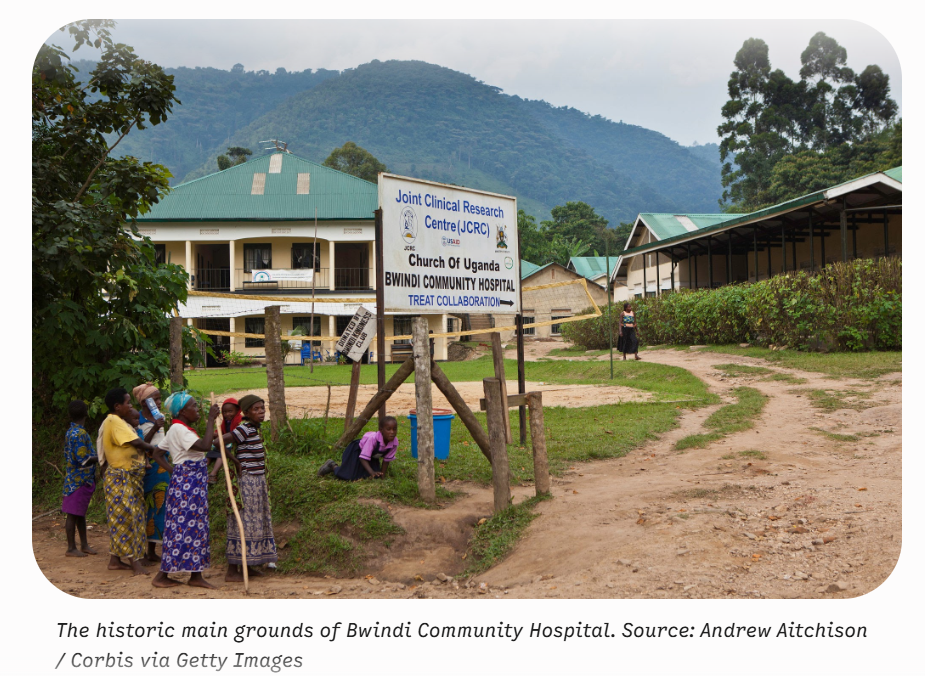
The crowning jewel of the Diocese’s healthcare mission is C.O.U. Bwindi Community Hospital. Founded in 2003 by US missionaries Dr. Scott Kellermann and his wife Carol, BCH began under the shade of a tree. Its initial mandate was urgent and specific: providing quality healthcare to the indigenous Batwa (pygmy) community, who had been displaced from their ancestral home when the Bwindi Impenetrable Forest was gazetted as a National Park.
Through years of tireless work, that tiny clinic evolved into a full-scale, 155-bed renowned community hospital. BCH has been globally and nationally celebrated for its pioneering healthcare models:
- Heroes in Health Awards (HIHA): Won the Use of ICT and Innovations to Improve Patient Care Award for integrating electronic medical records and mobile health (mHealth) tools to monitor maternal and infant health.
- Founder’s Legacy: Dr. Scott Kellermann was honored with the prestigious HIHA Lifetime Achievement Award for his decades of selflessness.
- International Acclaim: Recipient of the Prince Albert II of Monaco Prize for Innovative Philanthropy and the Stars Foundation Impact Award (UK) for its extraordinary commitment to reducing infant mortality among marginalized populations.
- Uganda Protestant Medical Bureau (UPMB): Consistently ranks BCH among the best-performing healthcare facilities in Uganda for its high-quality service delivery, community health insurance schemes, and obstetric fistula camps.
To read more about their ongoing projects, clinical services, or to offer support, visit the official platform: Bwindi Community Hospital Website.
A Comprehensive Network of Care
Beyond the main hospital hub, the Health Department coordinates a vital network across the entire Kinkiizi region to bring medicine where it is needed most.
- 15 Lower-Level Health Facilities: These centers form our front-line defense, scattered across rural areas to provide immediate relief and triage.
- Maternal & Child Health (MCH): Dedicated to safe motherhood, featuring advanced Neonatal Intensive Care Units (NICU) and specialized waiting hostels that have successfully driven down local maternal mortality.
- HIV/AIDS & Chronic Care: Comprehensive testing, counseling, and antiretroviral therapy (ART) delivery models that keep families healthy and intact.
Educational Revolution: Raising the Next Generation
As healthcare needs expanded, the Diocese recognized that treating patients was only half the battle—we needed to train the professionals who would care for them.
In 2013, the Uganda Nursing School Bwindi (UNSB) was established, followed by the Uganda College of Health Sciences Bwindi in 2018. Over the last decade, these institutions have graduated thousands of highly skilled midwives, nurses, and laboratory technicians, fundamentally transforming the local healthcare workforce.
The New Horizon: African University of Science and Management (AUSM)
We are thrilled to announce that our educational institutions have officially transitioned into a fully accredited higher-learning institution: the African University of Science and Management (AUSM).
Launched officially by the Bishop of Kinkiizi, Rt. Rev. Dan Zoreka, this university marks a monumental milestone for Kanungu District. Affiliated with the Church of Uganda, AUSM expands our academic horizon beyond medical disciplines into business, humanities, tourism, and hospitality management. With its main hubs located in Bwindi Buhoma Town Council and the newly acquired campus in Kambuga, AUSM stands ready to unlock higher education access and drive socio-economic transformation for youth across East Africa.
Overcoming Our Remaining Bottlenecks
Even as we celebrate these massive milestones, the department navigates heavy systemic challenges that require ongoing prayer and partnership:
- Pervasive Community Poverty: High financial barriers still prevent vulnerable women and children in distant villages from seeking timely care.
- Supervisory Transport Barriers: Managing 15 remote lower facilities requires reliable field transport. Our administration urgently needs dedicated supervisory vehicles to help Dr. Sadiiki Abel and the coordination team conduct essential quality assurance and clinical oversight visits safely.
Partner With Us
The story of Kinkiizi’s health transformation proves that with faith, visionary leadership, and collective effort, a clinic under a tree can grow to change an entire nation. We invite you to join us on this journey of healing and education.
Whether through healthcare philanthropy, sponsoring a student at the new African University of Science and Management, or assisting our field supervision transport fund, your partnership saves lives.
“We treat, God heals.”